
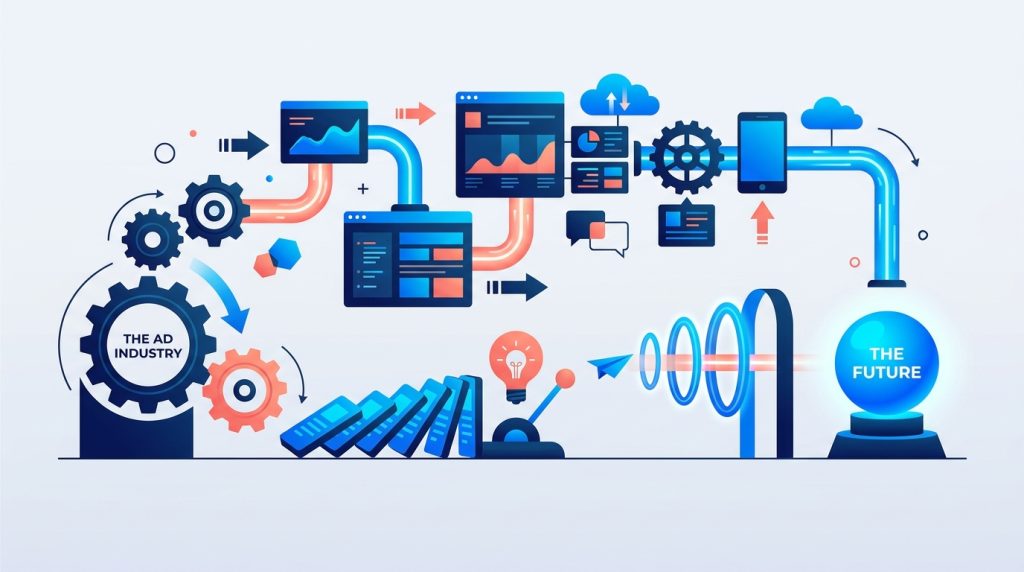
Here is the unvarnished truth hiding behind every Cannes yacht party and AI product launch this week: the marketing industry is not innovating. It is complicating. We are piling new ad formats, AI agents, and spin-off strategies on top of a foundation that was already cracked, and then we are surprised when trust erodes, measurement fails, and clients get frustrated. If you look past the press releases, the pattern is unmistakable. Every major trend this week — from AI poisoning to programmatic pause ads to NBCUniversal’s divorce from Comcast — points to the same conclusion: we are building a Rube Goldberg machine and calling it the future.
The AI Stack Is Collapsing Under Its Own Weight
The industry spent the last two years stuffing AI into every conceivable workflow, and now the bill is coming due. Digiday reports that agency bosses say the AI gap with clients is only getting wider — not because clients are behind, but because agencies have overpromised on tools that do not talk to each other. Meanwhile, Cadent and Google Cloud are now pitching “connected advertising intelligence” as a fix for the very fragmentation they helped create. That is not strategy. That is bundling.
And then there is the trust problem. People Inc.’s Jonathan Roberts put it bluntly: people do not trust AI; they trust creators. While brands rush to deploy AI agents like Profound’s new end-to-end marketing agent, consumers are getting better at spotting synthetic content — and rejecting it. Add Digiday’s warning about AI poisoning, where rivals can sabotage your brand’s LLM search presence with misinformation, and you have a channel that is simultaneously overhyped and under-secured. The irony? Publishers like Time are now rebuilding their websites specifically for AI agents to crawl — optimizing for a user base that does not actually trust the output.
CTV Is Adding Formats Faster Than It Can Measure Them
Connected TV has a measurement problem, and the industry’s solution is… more ad formats. The IAB Tech Lab is working to standardize programmatic signals for pause ads, because apparently viewers needed another reason to be annoyed. At the same time, dynamically inserted billboards are popping up in TV backgrounds, turning scripted content into a Minority Report-style ad surface. Groundbreaking or distracting? The question answers itself.
To be fair, there is real progress on the measurement front. CTV buyers are finally getting show-level performance optimization, which has been the Holy Grail since streaming became a serious ad channel. But let us not pretend that better reporting justifies stuffing more inventory into every corner of the viewing experience. The World Cup, as AdExchanger notes, is serving as a live outcomes test for programmatic live sports. If programmatic can prove itself at scale here, it finally earns its seat at the table. If it cannot, pause ads and digital billboards will look like distractions from the real problem: proving ROI.
Media Mega-Mergers Are Running on Fumes
Remember when consolidation was going to save the media business? AdExchanger has a blunt reminder: media mergers and spin-offs do not always keep their promises. Behind every consolidation headline is a frantic attempt to capitalize on streaming — often without a coherent plan for what happens to advertisers afterward.
This week’s Exhibit A: NBCUniversal’s “conscious uncoupling” from Comcast. As Digiday reports, the spin-off could reshape upfront negotiations and ad formats down the line — which is code for “we do not know yet, but it will definitely create headaches for buyers.” And Paramount is not faring much better. Its ad tech and product teams are consolidating under a former Google exec, a move that signals internal confusion more than strategic clarity. If you are an advertiser, the message is clear: the landscape is shifting beneath your feet, and the people doing the shifting are not sure where the floor is.
New Ad Frontiers: Real Opportunity or Just New Inventory?
Not everything this week was rearranging deck chairs. There were genuine attempts to open new territory. Electronic Arts is building its own ad stack to make in-game ads a real alternative to CTV, and unlike most “innovations,” this one solves an actual problem: reaching young, engaged audiences who do not watch traditional TV. EA is not renting someone else’s infrastructure; it is shaping the standards itself. That is the kind of vertical integration that can actually move markets.
Then there is OpenAI. AdExchanger reports that OpenAI is hiring for ad format innovation, signaling that its nascent ad platform is moving beyond search and into something that looks a lot more like… well, advertising. If OpenAI figures out how to monetize the post-click web without destroying user trust, it becomes a genuine platform challenger to Google and Meta. If it simply serves interruptive ads inside chat interfaces, it will join the long list of tech companies that mistook user attention for user tolerance.
The Privacy Reckoning Is Already Here
While everyone obsessed over AI and CTV formats, a quieter threat advanced. Digiday reports that “surveillance pricing” laws are coming for dynamic subscription strategies, with New York legislation and an active lawsuit that could force publishers to rethink how they use consumer data to set prices. This is not a GDPR-style compliance headache; this is a direct challenge to the business model of personalized monetization. If publishers can no longer use behavioral data to optimize pricing, the ripple effects will hit advertising too — because the same data pipelines feed both sides of the house.
The Bottom Line
This week’s stories do not paint a picture of an industry in decline. They paint a picture of an industry that has forgotten how to prioritize. We are building AI agents before we fix AI trust. We are adding CTV ad formats before we fix CTV measurement. We are spinning off media companies before we prove the last merger worked. The marketers who win the second half of 2026 will not be the ones with the shiniest tools. They will be the ones who strip away complexity, demand transparency, and refuse to confuse motion with progress. Everything else is just noise — and there is plenty of that to go around.